Current MLB ballpark · 1966 – present
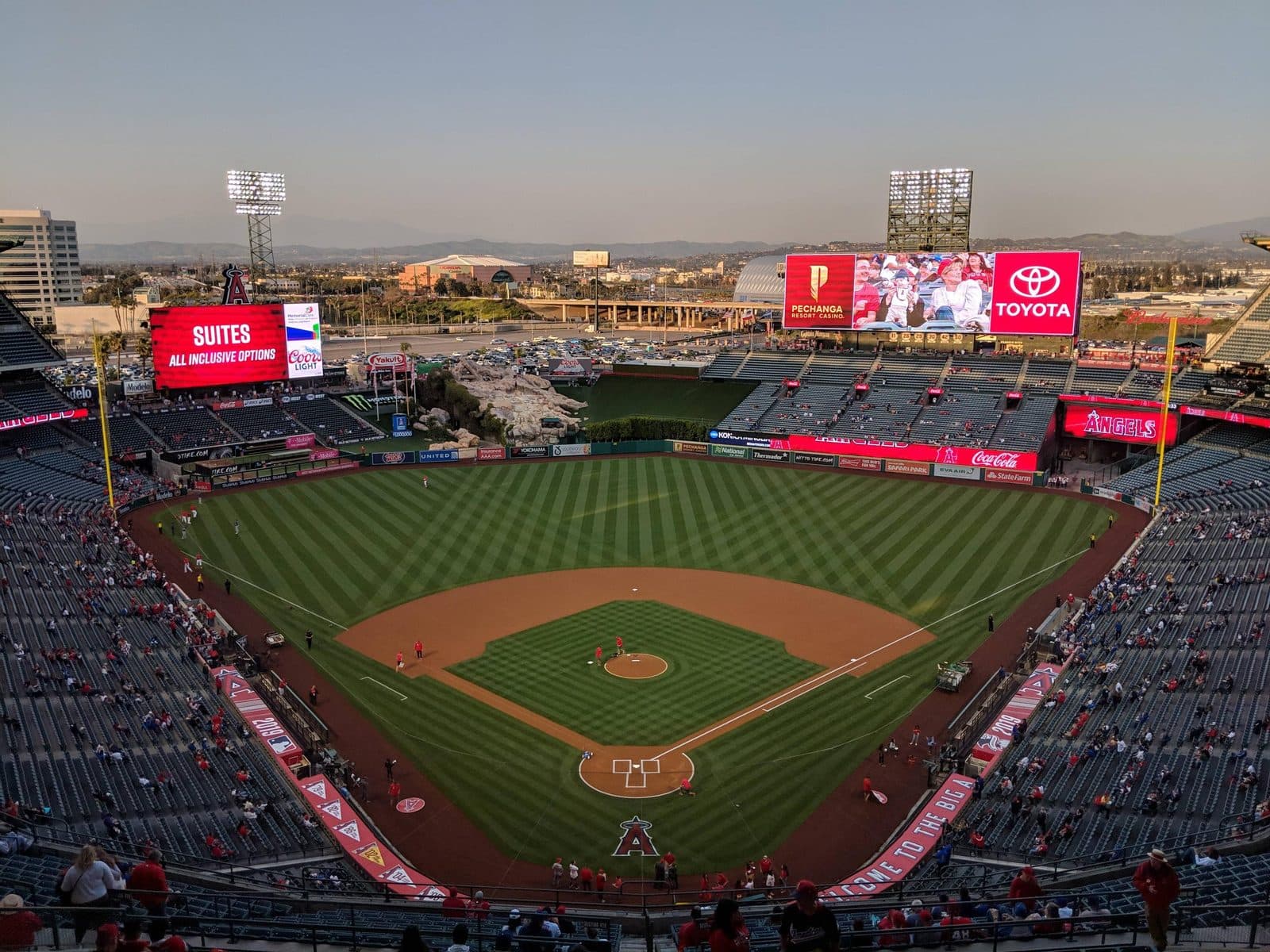
Angel Stadium
Anaheim, CA
Also known as Edison Field; Anaheim Stadium.
- Opened
- 1966
- Capacity
- 45,517
- Surface
- Grass
- Roof
- Open
- League
- AL
- Elevation
- 151 ft
- Orientation
- 43.61° (NE)
- Time zone
- America/Los_Angeles
How it plays
Every number is an index where 100 is league average. There is no such thing as one park factor — this park does different things to a triple than it does to a home run, and the only honest version is the whole row. Off 17,729 plate appearances in 2026.
| 2026 | 2024-2026 | |
|---|---|---|
| Runs | 85 | 98 |
| Home runs | 70 | 100 |
| Triples | 62 | 84 |
| Doubles | 80 | 90 |
| Singles | 103 | 100 |
| Walks | 93 | 99 |
| Strikeouts | 112 | 106 |
| Value on contact | 93 | 100 |
| Expected on contact | 99 | 99 |
How much of this is the park? Across 2022–2026, this venue's single-season value-on-contact index moved by ±4.1 points (a 11-point spread over 5 seasons). The league median is 3.0. Read a single season's figure with that much slack in it — the walls do not move, and the number does.
By the batter's side
| Runs | 77 RHB | 94 LHB |
| Home runs | 71 RHB | 68 LHB |
| Value on contact | 89 RHB | 98 LHB |
10,719 right-handed and 7,010 left-handed plate appearances — each side is half a season, so read these with at least the slack the combined figures carry — the band above is ±4.1 on twice this sample.
What FVR does about it
Every luck gap we measure at this park has −0.0210 subtracted from it, off 3,897 balls in play here this season. That is the number behind every board on this site, which is the only reason it is printed. It is not on the 100-is-average scale above: it is value on contact per ball in play, so it cannot be added to or subtracted from any index in this table. The two can even point opposite ways — Savant's runs index counts all offense, ours is only the residual against what the batted balls deserved.
Index figures: Baseball Savant, single-season and three-year rolling. What a park factor is, and is not →
The lore
The Big A at Sixty
Angel Stadium has stood in Anaheim since 1966, and the halo still lights up after a win.
The Big A
When the stadium opened on April 9, 1966, the feature that made it itself was already standing beyond the outfield: a scoreboard 23 stories high, costing one million dollars, twice as tall as any other building in Orange County at the time. They called it the Big A. Architect Noble Herzberg, who had worked on D.C. Stadium and prior Yankee Stadium renovations, borrowed from RFK's multiuse concept, but the Big A was Anaheim's own. The halo lights up after Angels victories, and it still does.
The Ground
Anaheim was a city of roughly 150,000 residents surrounded by cornfields and citrus trees when the ballpark went up — already on the map because of nearby Disneyland, and looking for a second draw. Over 40,000 fans showed up on opening day to see the Big A come to life. The total project cost about $24 million in city bonds, real estate, scoreboard, and equipment, with an initial baseball capacity near 45,000. The park holds 45,517 today.
Center field measures 396 feet — the second-shortest in the American League, tied for fourth-shortest in the majors. The lines run 330 to left, 330 to right. Despite that shallow center, Nolan Ryan threw two of his seven career no-hitters in this park and recorded 2,416 of his 5,714 career strikeouts here.
Sixty Seasons
The stadium is the fourth-oldest active ballpark in the majors, behind Fenway Park, Wrigley Field, and Dodger Stadium. It has hosted the All-Star Game three times — 1967, 1989, and 2010 — and the 2002 World Series, which the Angels won over the San Francisco Giants for the franchise's first championship. The park has also seen six American League Championship Series and seven AL Division Series.
The Angels have been the only club to call it home. Sixty seasons of baseball on the same Anaheim ground, and the halo still goes on after a win.
Reporting: Los Angeles Times, Ballpark Digest, MLB.com, Wikipedia. Park data: MLB StatsAPI and Retrosheet, via the Fever engine.
By the Desk · filed 2026-07-23 — the piece reads as of its filing; the park record around it is live · every fact in this piece comes from a filed, sourced research pack and clears an independent fact-check, and nothing is edited after filing.
The dimensions
Fence distances from home plate, in feet — the same venue.fieldInfo the scorecards draw their hit charts on.
| Left field line | 330′ |
| Left field | 347′ |
| Left-center | 389′ |
| Center field | 396′ |
| Right-center | 365′ |
| Right field | 348′ |
| Right field line | 330′ |
Home club
Games we’ve scored here
81 games at this park in our books — every one transcribed mark for mark, reconciled to the official line. The most recent:
- 2026-09-20MIN 8 – 0 LAA
- 2026-09-19MIN 5 – 6 LAA
- 2026-09-18MIN 3 – 0 LAA
- 2026-09-17MIN 4 – 5 LAA
- 2026-09-16SEA 7 – 2 LAA
- 2026-09-15SEA 1 – 2 LAA
- 2026-09-14SEA 4 – 6 LAA
- 2026-09-02NYY 6 – 3 LAA
- 2026-09-01NYY 7 – 3 LAA
- 2026-08-31NYY 1 – 10 LAA
- 2026-08-30PHI 5 – 2 LAA
- 2026-08-29PHI 4 – 2 LAA
…and 69 more in the scorecard archive.
Where it stands
2000 Gene Autry Way, Anaheim, CA 92806. Open the map →
Sources
- MLB StatsAPI · as of 2026-07-23
- Retrosheet · as of 2026-07-23
The information used here was obtained free of charge from and is copyrighted by Retrosheet. Interested parties may contact Retrosheet at 20 Sunset Rd., Newark, DE 19711.