Former ballpark · 1902 – 1911
Palace of the Fans
Cincinnati, OH
Also known as League Park III.
- Opened
- 1902
- Closed
- 1911
- League
- NL
The lore
No Dugouts
Cincinnati's Palace of the Fans was built for the people in the seats and forgotten the people on the field.
No Dugouts
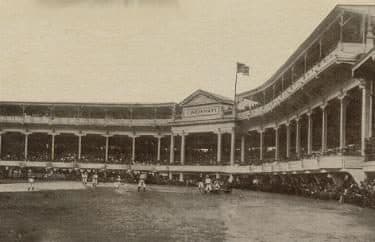
The architects who drew up Palace of the Fans gave Cincinnati 22 hand-carved Corinthian columns, opera-style private boxes, and carriage stalls so the wealthy could drive directly to the game. They forgot to include dugouts or clubhouses for the players.
The park, also known as League Park III, rose on the ashes of League Park, which had burned in 1900 and 1901, at Findlay Street and McLean Avenue — the same site as two previous League Parks. An 1884 grandstand survived the fire and served as right-field seating. The new structure, inspired by Chicago's 1893 World's Columbian Exposition, was only the second ballpark after Philadelphia's Baker Bowl to use concrete for most of its construction. It opened on April 17, 1902, with the Reds losing to the Chicago Colts, 6-1, before roughly 10,000 spectators.
Rooters Row
The park held 12,000, with a 3,000-seat main grandstand and 19 fashion boxes along the front railing. Beneath the grandstand, at field level, stood Rooters Row — standing room for 640 fans, separated from the players by nothing more than plywood and chicken wire. They were close enough to join in on-field conversations, and the section sat strategically near the bar, which made it a lively gathering spot for the loudest supporters in the house.
On June 19, 1909, the park hosted an exhibition game under temporary lighting developed by George F. Cahill, an experiment judged a success and a precursor to night baseball. The Cincinnati Bearcats college football team also used the grounds from 1904 to 1906 and again in 1908 and 1909.
By 1911, the Palace had cracked girders, decayed supports, and unsafe floors. City inspectors noted the deterioration. The Reds played their final game there in October against the Cubs — the same club they had faced on opening day. Workmen began demolishing the structure immediately after the game to make way for Redland Field, which opened in 1912.
Reporting: Wikipedia, Ballparks of Baseball, Project Ballpark. Park data: MLB StatsAPI and Retrosheet, via the Fever engine.
By the Desk · filed 2026-07-24 — the piece reads as of its filing; the park record around it is live · every fact in this piece comes from a filed, sourced research pack and clears an independent fact-check, and nothing is edited after filing.
Where it stood
Cincinnati, OH. We don’t have exact coordinates for this park in the historical record — we’d rather say so than pin the wrong spot.
Sources
- Retrosheet · as of 2026-07-23
The information used here was obtained free of charge from and is copyrighted by Retrosheet. Interested parties may contact Retrosheet at 20 Sunset Rd., Newark, DE 19711.