Former ballpark · 1969 – 2003
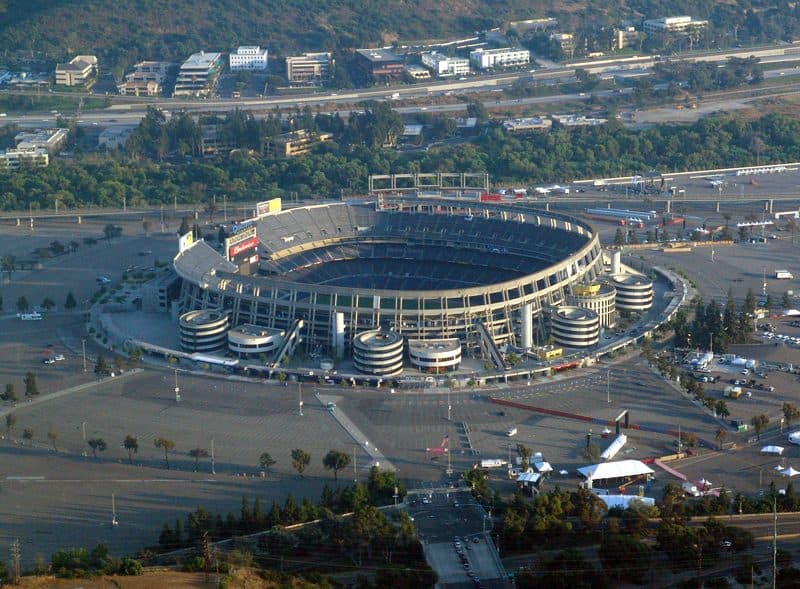
Qualcomm Stadium
San Diego, CA
Also known as San Diego/Jack Murphy Stadium.
- Opened
- 1969
- Closed
- 2003
- League
- NL
The lore
The Horseshoe in San Diego
A Brutalist park that opened in 1969, kept being reshaped, and folded two Hall of Fame careers into one October afternoon.
On October 7, 2001, Rickey Henderson collected his 3,000th major league hit, playing for San Diego. That same game was the last major league appearance for Tony Gwynn — eight-time National League batting champion, Hall of Famer, a Padre for his entire career. Two milestones folded into one afternoon at a park that had been reworked so many times it barely resembled what opened in 1969.
The Ground
San Diego Stadium was a Brutalist horseshoe — three-tiered, the east end low and capped by a large scoreboard. The outfield was ringed by a 19-foot wall whose top was the rim of the Plaza level, making home runs difficult to hit. An eight-foot fence later went up inside it, pulling the lines to 327 feet and center to 405. The Padres played their first home game there on April 8, 1969, edging Houston 2-1 before 23,370 fans.
On September 28, 1988, Orel Hershiser of the Dodgers broke Don Drysdale's consecutive scoreless inning streak on this field, a road game against the Padres. Two years later, before a Padres game in 1990, comedian Roseanne Barr gave a rendition of the Star-Spangled Banner that became one of the most talked-about national anthem performances in sports history.
The Changes
The park kept being reshaped. In 1996, a 19-foot scoreboard displaying out-of-town scores went up along the right-field wall near the foul pole and was ruled in play — right field became 330 feet, right-center 370. In the final five seasons, 1999 through 2003, the home plate area took on the shape of home plate itself rather than the standard circle. In 1997, Qualcomm Corporation paid $18 million for naming rights and the building became Qualcomm Stadium, though the city kept the field named for Jack Murphy, the sportswriter. The next year the park became the only stadium ever to host both the Super Bowl and the World Series in the same year.
The Padres called it home from 1969 through 2003, then moved to Petco Park downtown.
Reporting: SABR, Wikipedia. Park data: MLB StatsAPI and Retrosheet, via the Fever engine.
By the Desk · filed 2026-07-24 — the piece reads as of its filing; the park record around it is live · every fact in this piece comes from a filed, sourced research pack and clears an independent fact-check, and nothing is edited after filing.
Where it stood
San Diego, CA. We don’t have exact coordinates for this park in the historical record — we’d rather say so than pin the wrong spot.
Sources
- Retrosheet · as of 2026-07-23
The information used here was obtained free of charge from and is copyrighted by Retrosheet. Interested parties may contact Retrosheet at 20 Sunset Rd., Newark, DE 19711.