Current MLB ballpark · 1999 – present
T-Mobile Park
Seattle, WA
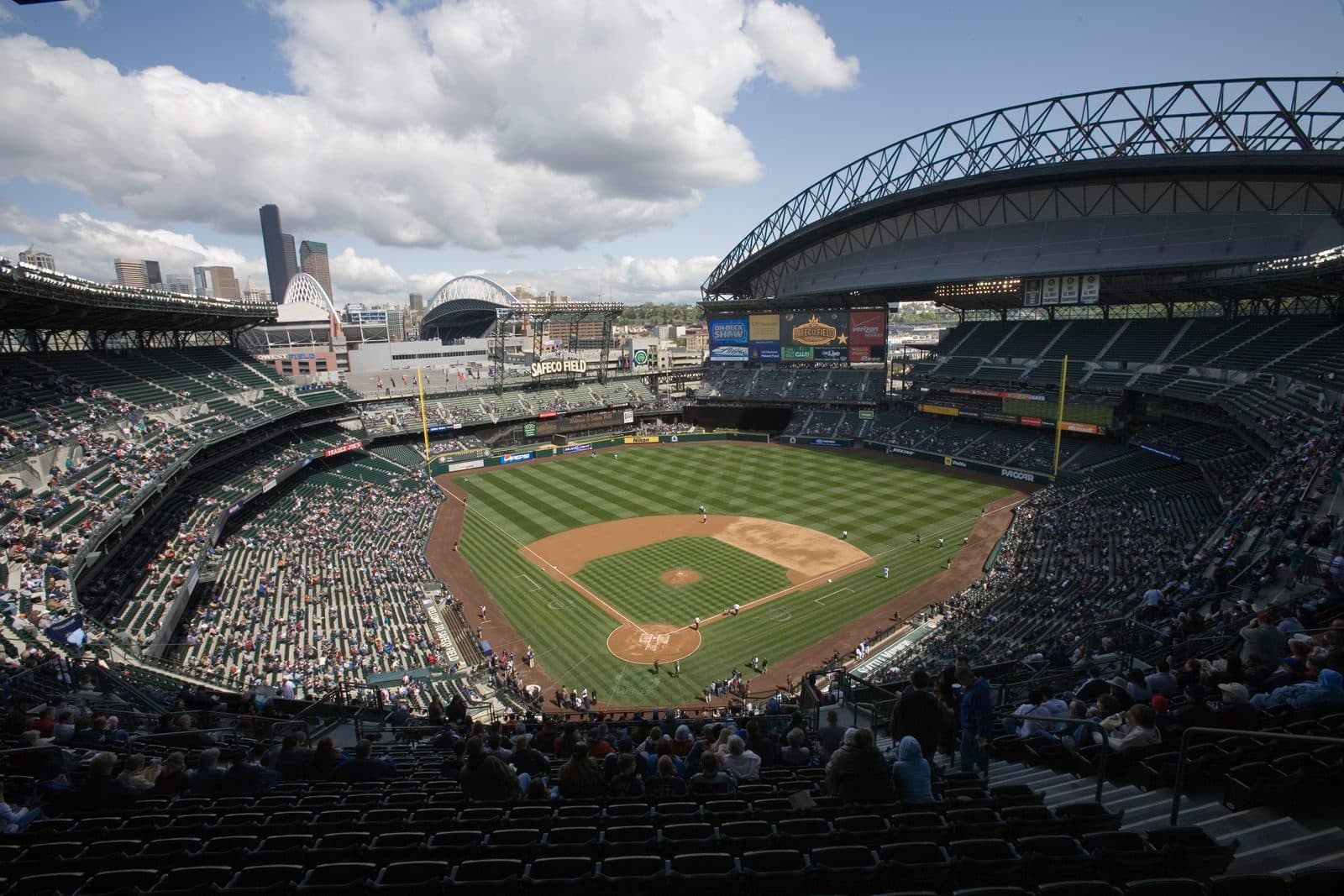
- Opened
- 1999
- Capacity
- 47,929
- Surface
- Grass
- Roof
- Retractable
- League
- AL
- Elevation
- 10 ft
- Orientation
- 49° (NE)
- Time zone
- America/Los_Angeles
How it plays
Every number is an index where 100 is league average. There is no such thing as one park factor — this park does different things to a triple than it does to a home run, and the only honest version is the whole row. Off 17,298 plate appearances in 2026.
| 2026 | 2024-2026 | |
|---|---|---|
| Runs | 88 | 85 |
| Home runs | 104 | 98 |
| Triples | 32 | 40 |
| Doubles | 82 | 86 |
| Singles | 94 | 91 |
| Walks | 96 | 96 |
| Strikeouts | 113 | 116 |
| Value on contact | 96 | 95 |
| Expected on contact | 99 | 100 |
How much of this is the park? Across 2022–2026, this venue's single-season value-on-contact index moved by ±0.9 points (a 2-point spread over 5 seasons). The league median is 3.0. Read a single season's figure with that much slack in it — the walls do not move, and the number does.
By the batter's side
| Runs | 83 RHB | 92 LHB |
| Home runs | 93 RHB | 114 LHB |
| Value on contact | 94 RHB | 98 LHB |
7,840 right-handed and 9,457 left-handed plate appearances — each side is half a season, so read these with at least the slack the combined figures carry — the band above is ±0.9 on twice this sample.
What FVR does about it
Every luck gap we measure at this park has −0.0142 subtracted from it, off 3,899 balls in play here this season. That is the number behind every board on this site, which is the only reason it is printed. It is not on the 100-is-average scale above: it is value on contact per ball in play, so it cannot be added to or subtracted from any index in this table. The two can even point opposite ways — Savant's runs index counts all offense, ours is only the residual against what the batted balls deserved.
Index figures: Baseball Savant, single-season and three-year rolling. What a park factor is, and is not →
The lore
The Canopy on SoDo
A retractable canopy in SoDo — the Mariners' home since 1999, where two perfect games were thrown in a single season.
The Canopy
The retractable roof at T-Mobile Park does not fully enclose the venue. That is the engineering choice that defines the place. After more than two decades in the Kingdome — an enclosed concrete structure that trapped noise and played on artificial turf — the Mariners moved into a retro-style home in 1999 with real grass, blue skies, and views of the Olympic Mountains. The roof's sole purpose is to shield fans and players from Seattle's frequent rain. Instead of controlling temperature, it acts as a canopy, leaving the sides open so the park preserves an open-air environment even when the weather does not cooperate. The move from the Kingdome was a dramatic upgrade for the fan experience, trading concrete and turf for grass and daylight.
NBBJ, a Seattle-based architecture firm, designed the building with a retro-style red brick exterior and a hand-operated scoreboard, set in the SoDo neighborhood just south of downtown Seattle. Construction took 27 months, from a March 1997 groundbreaking to a July 1999 opening, and the total cost reached $517.6 million through change orders and overruns — the most expensive stadium in the United States at the time. The park holds 47,929. The field plays 331 feet down the left-field line, 401 to dead center, and 326 down the right-field line, at an elevation of ten feet.
Two Perfect Games
In 2012, in a rare occurrence for a single venue, two perfect games were thrown at the park. Chicago White Sox pitcher Philip Humber threw the first in stadium history. Later that same season, Mariners ace Felix Hernandez matched the feat, defeating the Tampa Bay Rays 1-0 for the 23rd perfect game in Major League history.
Third baseman Russ Davis hit the park's first home run during the early days of that opening season, and Raul Ibanez hit the first grand slam. The 2026 season is the 28th season of baseball at the park. The Mariners have called it home since opening day, and the canopy still slides shut for rain.
Reporting: MLB.com, HistoryLink, Ballpark.org. Park data: MLB StatsAPI and Retrosheet, via the Fever engine.
By the Desk · filed 2026-07-24 — the piece reads as of its filing; the park record around it is live · every fact in this piece comes from a filed, sourced research pack and clears an independent fact-check, and nothing is edited after filing.
The dimensions
Fence distances from home plate, in feet — the same venue.fieldInfo the scorecards draw their hit charts on.
| Left field line | 331′ |
| Left-center | 378′ |
| Center field | 401′ |
| Right-center | 381′ |
| Right field line | 326′ |
Home club
Games we’ve scored here
81 games at this park in our books — every one transcribed mark for mark, reconciled to the official line. The most recent:
- 2026-09-27LAA 3 – 7 SEA
- 2026-09-26LAA 4 – 8 SEA
- 2026-09-25LAA 7 – 5 SEA
- 2026-09-24LAA 6 – 4 SEA
- 2026-09-23HOU 5 – 6 SEA
- 2026-09-22HOU 7 – 0 SEA
- 2026-09-10TEX 3 – 4 SEA
- 2026-09-09TEX 2 – 3 SEA
- 2026-09-08TEX 10 – 5 SEA
- 2026-09-06ATH 0 – 2 SEA
- 2026-09-05ATH 6 – 2 SEA
- 2026-09-04ATH 7 – 6 SEA
…and 69 more in the scorecard archive.
Where it stands
P.O. Box 4100, Seattle, WA 98104. Open the map →
Sources
- MLB StatsAPI · as of 2026-07-23
- Retrosheet · as of 2026-07-23
The information used here was obtained free of charge from and is copyrighted by Retrosheet. Interested parties may contact Retrosheet at 20 Sunset Rd., Newark, DE 19711.