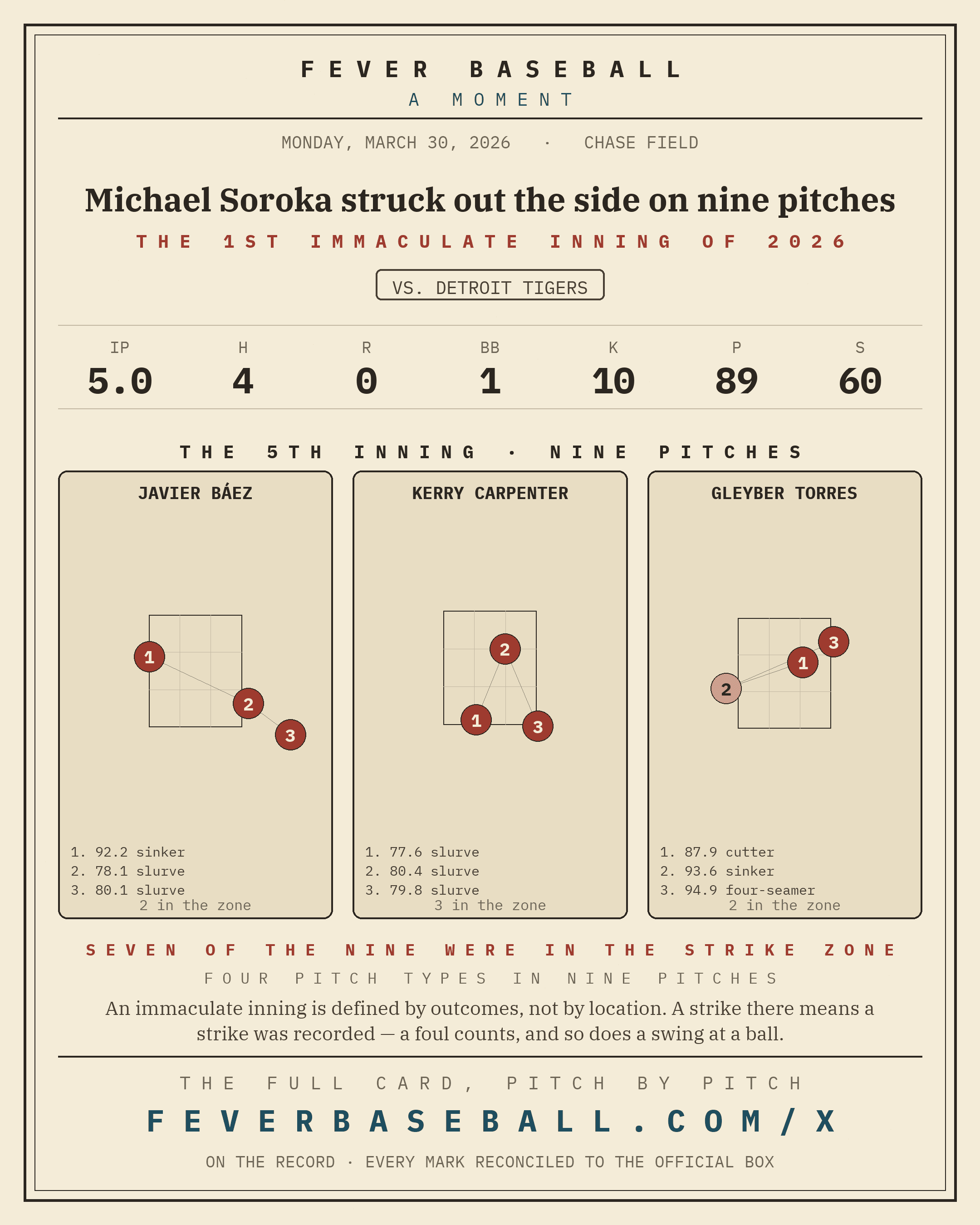
Javier Báez led off the fifth. Michael Soroka started him with a strike, then another, then a third. Báez swung through it.
Kerry Carpenter followed. Three pitches, three strikes, swinging strikeout. Then Gleyber Torres, same thing.
Nine pitches, three strikeouts, no balls called. That is an immaculate inning, the first of 2026.
What makes it rare is what it requires: three hitters, each failing completely, in sequence. One foul ball with two strikes and the at-bat extends. One take that draws a ball and the inning is no longer immaculate. Every pitch has to be a strike — called, fouled, or swung through — and it has to happen immediately, nine times running, with no reset. Soroka never threw a fourth pitch to any of the three.
The scorecard tells you how. Seven of the nine pitches were in the strike zone. Two were not. Those two had to be swung at, because a pitch outside the zone that a hitter takes is a ball, and there were no balls. Both were chased. All three strikeouts were swinging.
Seven in nine is an unusually high rate for an immaculate inning. The feat counts outcomes, not locations: a recorded strike can be called, fouled, or chased off the plate. "Nine strikes" does not mean nine pitches in the zone, and usually it doesn't. Most immaculate innings run on chases and fouls. This one ran mostly on Soroka throwing where the hitter had to defend, and the hitter not being able to do anything with it.
His full line for the night: five innings, 10 strikeouts, four hits, one walk, 89 pitches. The fifth inning used nine of those pitches and produced three of those strikeouts. Arizona won, 9–6.