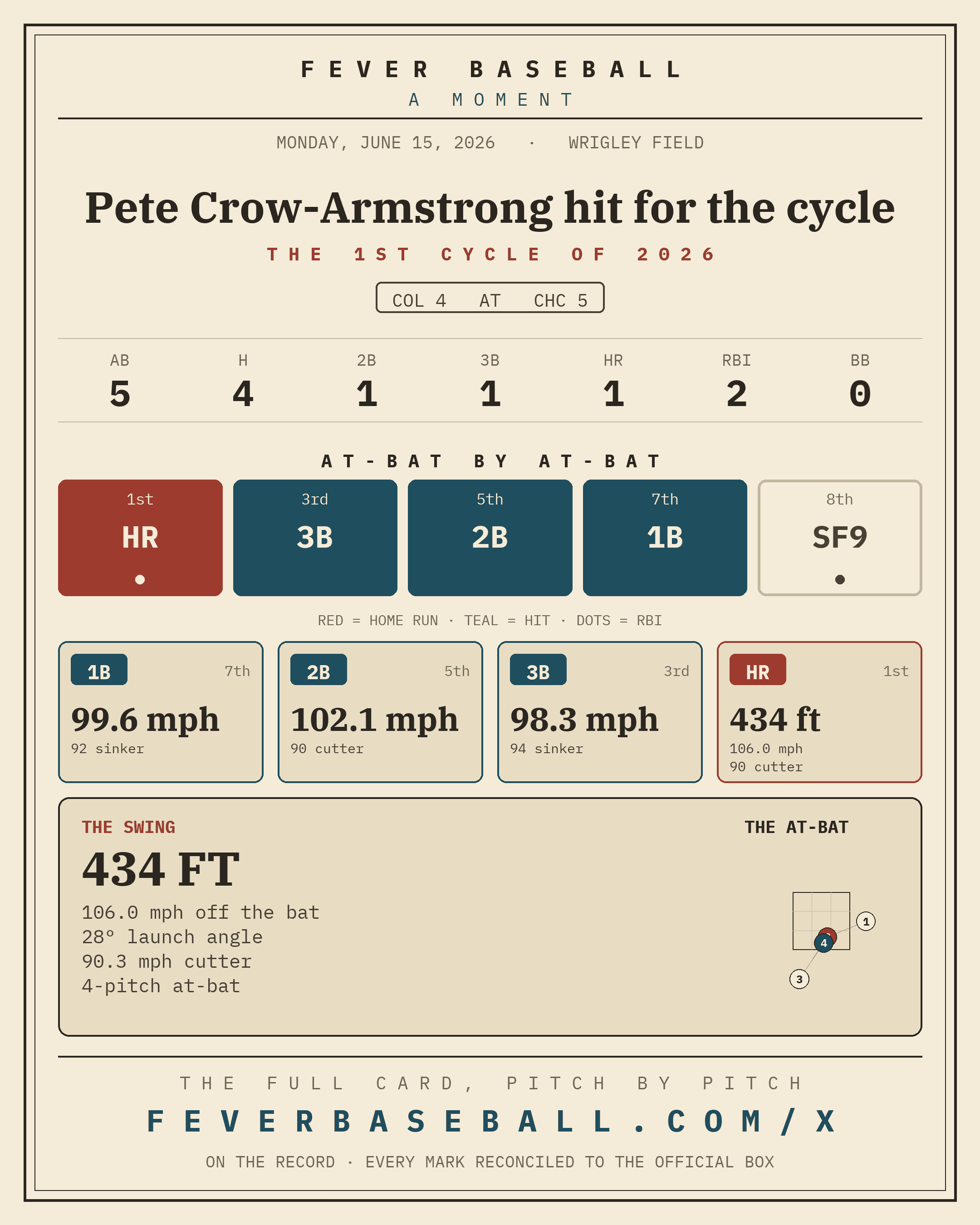
The home run came first. Pete Crow-Armstrong put one on a fly ball to center field — his 13th of the year — and the cycle was not yet a thought. It never is. The cycle is a thing that announces itself only after it is half-finished, and by then it is already the hardest part of the conversation.
A cycle is four hits in one game: a single, a double, a triple, and a home run. The difficulty is the triple. Anyone who can reach the big leagues can find a single in a night. Plenty can find a double. The home run is its own separate skill, available or not on a given swing. The triple is the one that requires a confluence — a ball hit deep enough to run three, a fielder slow to retrieve it, a runner fast enough to keep going, and the judgment to try. It is the piece that turns four good swings into a line in the record book.
Crow-Armstrong got his next. A fly ball to right fielder Tyler Freeman that became his fourth triple of the season. Then a double — a sharp line drive to Freeman again. Then a single — a line drive to Freeman, once more. Three of the four hits in the cycle, plus a sacrifice fly that scored Matt Shaw, all went to the same man in right field. Freeman was the unwilling witness to most of it.
The order mattered. Crow-Armstrong did not build toward the home run. He started with it, the most forceful swing of the night, and then worked his way down the ladder — homer, triple, double, single — until the only thing left was a line drive to right that would settle in front of Freeman instead of over him. The single completed it. He had 10 total bases and two RBI on a night the Cubs won 5–4.
A cycle is not a stat you chase. It is a stat that happens to you across nine innings, one swing at a time, each one sufficient on its own and meaningless in aggregate until the last one lands. Crow-Armstrong became the first man in 2026 to collect all four. Four hits, three for extra bases, in a one-run game at Wrigley Field. The single was the quietest swing of the night, a line drive to right, and it was the one that finished the thing.