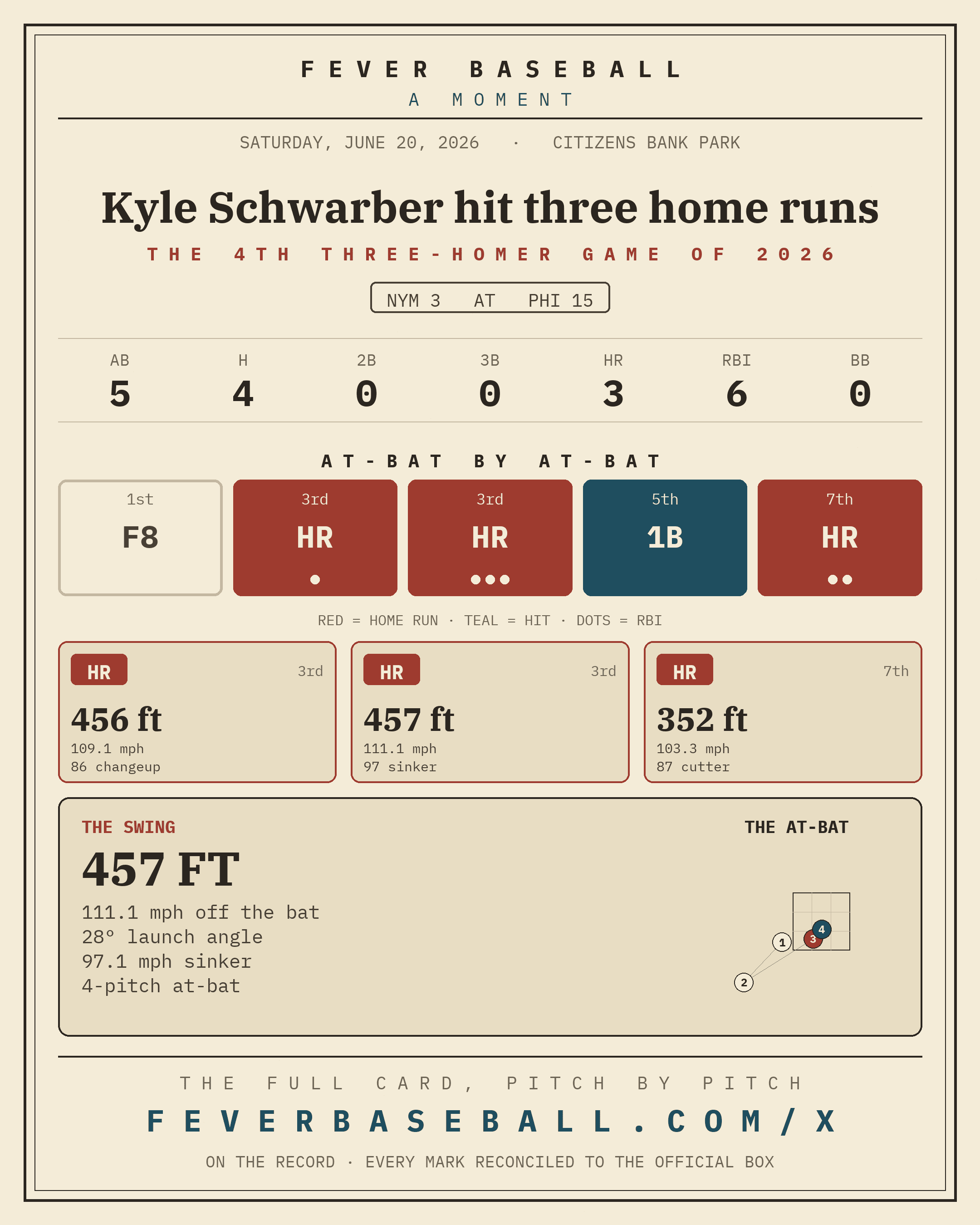
Kyle Schwarber's first swing of the night produced a fly ball to center fielder Carson Benge. An out.
His next time up he hit home run number 26, a fly ball to right center field.
The time after that, home run number 27 — same part of the park, Justin Crawford and Trea Turner on base, three runs scoring.
Then a sharp line drive single to right fielder Eric Wagaman, moving Turner to second.
Then home run number 28, a fly ball to right field, Turner scoring again.
Four hits. Six runs batted in. Three home runs. The only out was the first one.
The longest of the three traveled 457 feet; the hardest contact registered 111.1 mph. Two of the home runs went to right center, the third to right. All three were fly balls that carried over the fence.
Three home runs by one player in one game had happened three times in all of 2026 before June 20. Schwarber made it the fourth.
The difficulty is the repetition. One home run is a good night. Two is a career highlight for most players. Three requires recognizing the baseball correctly across three separate plate appearances, against pitching that has already watched you do it twice. The barrel has to arrive on time each time, and the recognition has to hold across five at-bats. Schwarber flew out to center his first time up. After that, four balls in play, all of them hit hard, three of them over the wall.