Former ballpark · 1913 – 1957
Ebbets Field
Brooklyn, NY
- Opened
- 1913
- Closed
- 1957
- League
- NL
The lore
The Block Charles Ebbets Assembled
A trapezoidal lot in Flatbush produced a ballpark that never played fair, and two afternoons in Brooklyn that the game could not contain.
The Shape of the Block
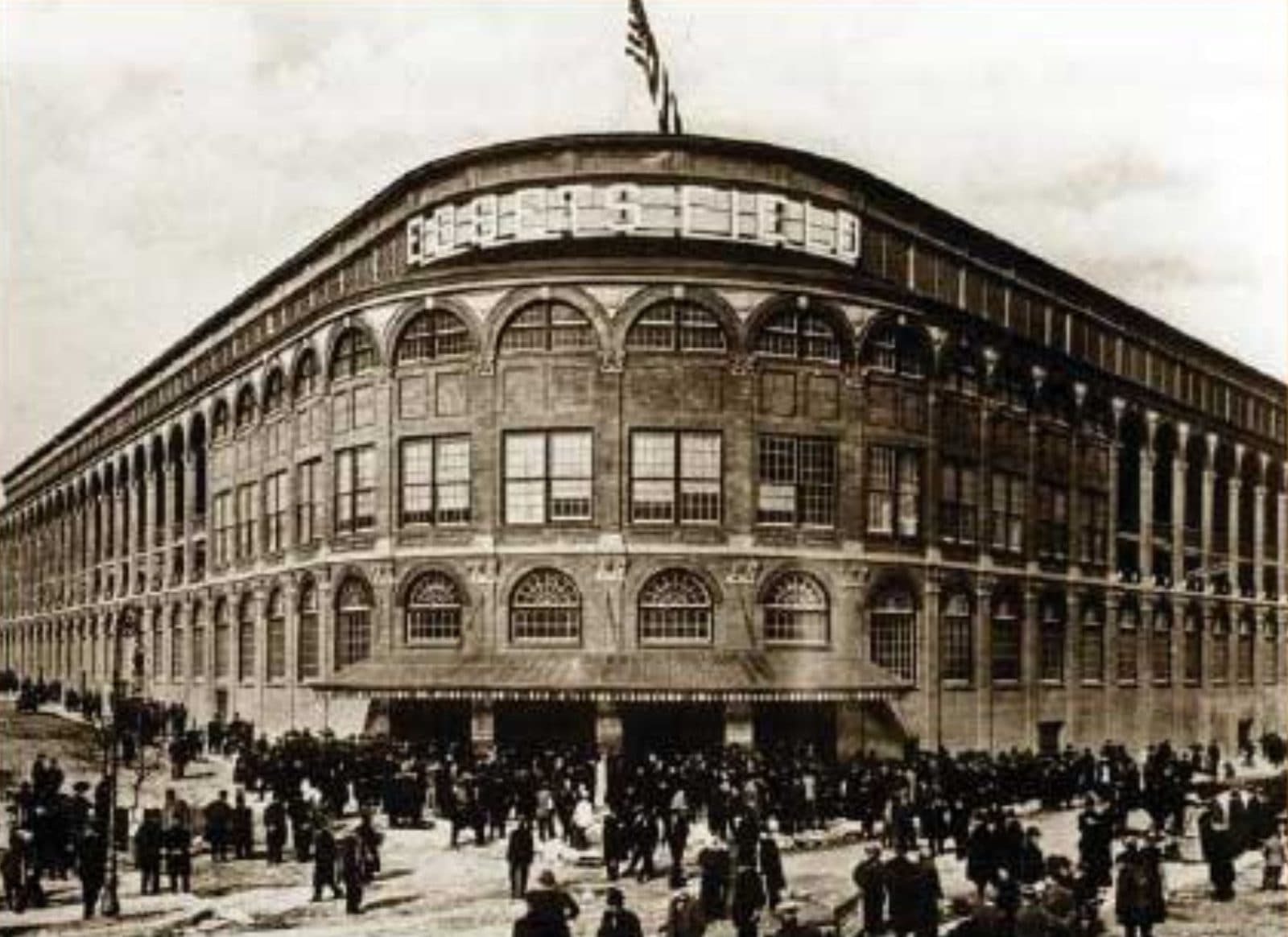
Charles Ebbets began buying lots in 1908, piecing together the full block bounded by Bedford Avenue, Sullivan Place, Cedar Street (later McKeever Place), and Montgomery Street in Brooklyn's Flatbush section. The lot was trapezoidal and the ground sloped, and that geometry produced a right-field foul line of just 301 feet while center field stretched past 500. Left field sat at 419. The place never played fair; it was built on a piece of ground that had its own ideas about distance.
The Front Door
Ebbets Field opened on April 9, 1913, with Brooklyn losing to the Philadelphia Phillies 1-0. The steel-and-concrete stadium cost $750,000, and its entrance was an 80-foot rotunda with an Italian marble floor, a chandelier, and coat-check rooms — designed to give fans a theater-like experience before they reached their seats. Over the right-field wall, which came to carry a scoreboard and nearly 300 different angles, a Schaefer Beer advertisement lit up the letter "h" or the letter "e" to signal whether the official scorer had ruled a hit or an error.
Two Afternoons
On June 15, 1938, in the first night game at Ebbets Field, Cincinnati's Johnny Vander Meer threw his second consecutive no-hitter before 38,748 fans — a feat that has not been duplicated. Nine years later, on April 15, 1947, Jackie Robinson ran out to first base and broke the color line that had kept Black players out of the National and American Leagues since the 1880s. Arthur Daley of the New York Times called Robinson's debut quite uneventful, and the crowd fell short of a sellout. The moment was a watershed in American history.
Gone
The Dodgers played their final game there on September 24, 1957, before Walter O'Malley moved the club to California. Demolition began in February 1960, using the same wrecking ball that would later take down the Polo Grounds.
Reporting: Society for American Baseball Research, MLB.com, Baseball Reference, Wikipedia. Park data: MLB StatsAPI and Retrosheet, via the Fever engine.
By the Desk · filed 2026-07-24 — the piece reads as of its filing; the park record around it is live · every fact in this piece comes from a filed, sourced research pack and clears an independent fact-check, and nothing is edited after filing.
Where it stood
Brooklyn, NY. We don’t have exact coordinates for this park in the historical record — we’d rather say so than pin the wrong spot.
Sources
- Retrosheet · as of 2026-07-23
The information used here was obtained free of charge from and is copyrighted by Retrosheet. Interested parties may contact Retrosheet at 20 Sunset Rd., Newark, DE 19711.