Current MLB ballpark · 1914 – present
Wrigley Field
Chicago, IL
Also known as Weeghman Park; Cubs Park.
- Opened
- 1914
- Capacity
- 41,363
- Surface
- Grass
- Roof
- Open
- League
- NL
- Elevation
- 595 ft
- Orientation
- 37° (NE)
- Time zone
- America/Chicago
How it plays
Every number is an index where 100 is league average. There is no such thing as one park factor — this park does different things to a triple than it does to a home run, and the only honest version is the whole row. Off 18,191 plate appearances in 2026.
| 2026 | 2024-2026 | |
|---|---|---|
| Runs | 106 | 96 |
| Home runs | 117 | 106 |
| Triples | 134 | 122 |
| Doubles | 81 | 81 |
| Singles | 103 | 98 |
| Walks | 105 | 102 |
| Strikeouts | 95 | 101 |
| Value on contact | 101 | 97 |
| Expected on contact | 99 | 99 |
How much of this is the park? Across 2022–2026, this venue's single-season value-on-contact index moved by ±3.8 points (a 10-point spread over 5 seasons). The league median is 3.0. Read a single season's figure with that much slack in it — the walls do not move, and the number does.
By the batter's side
| Runs | 106 RHB | 104 LHB |
| Home runs | 109 RHB | 127 LHB |
| Value on contact | 100 RHB | 104 LHB |
10,415 right-handed and 7,776 left-handed plate appearances — each side is half a season, so read these with at least the slack the combined figures carry — the band above is ±3.8 on twice this sample.
What FVR does about it
Every luck gap we measure at this park has −0.0021 subtracted from it, off 4,251 balls in play here this season. That is the number behind every board on this site, which is the only reason it is printed. It is not on the 100-is-average scale above: it is value on contact per ball in play, so it cannot be added to or subtracted from any index in this table. The two can even point opposite ways — Savant's runs index counts all offense, ours is only the residual against what the batted balls deserved.
Index figures: Baseball Savant, single-season and three-year rolling. What a park factor is, and is not →
The lore
The Brick and the Vine
A park that started as a Federal League experiment, found its shape in the thirties, and has been the Cubs' home since 1916.
The Brick and the Vine
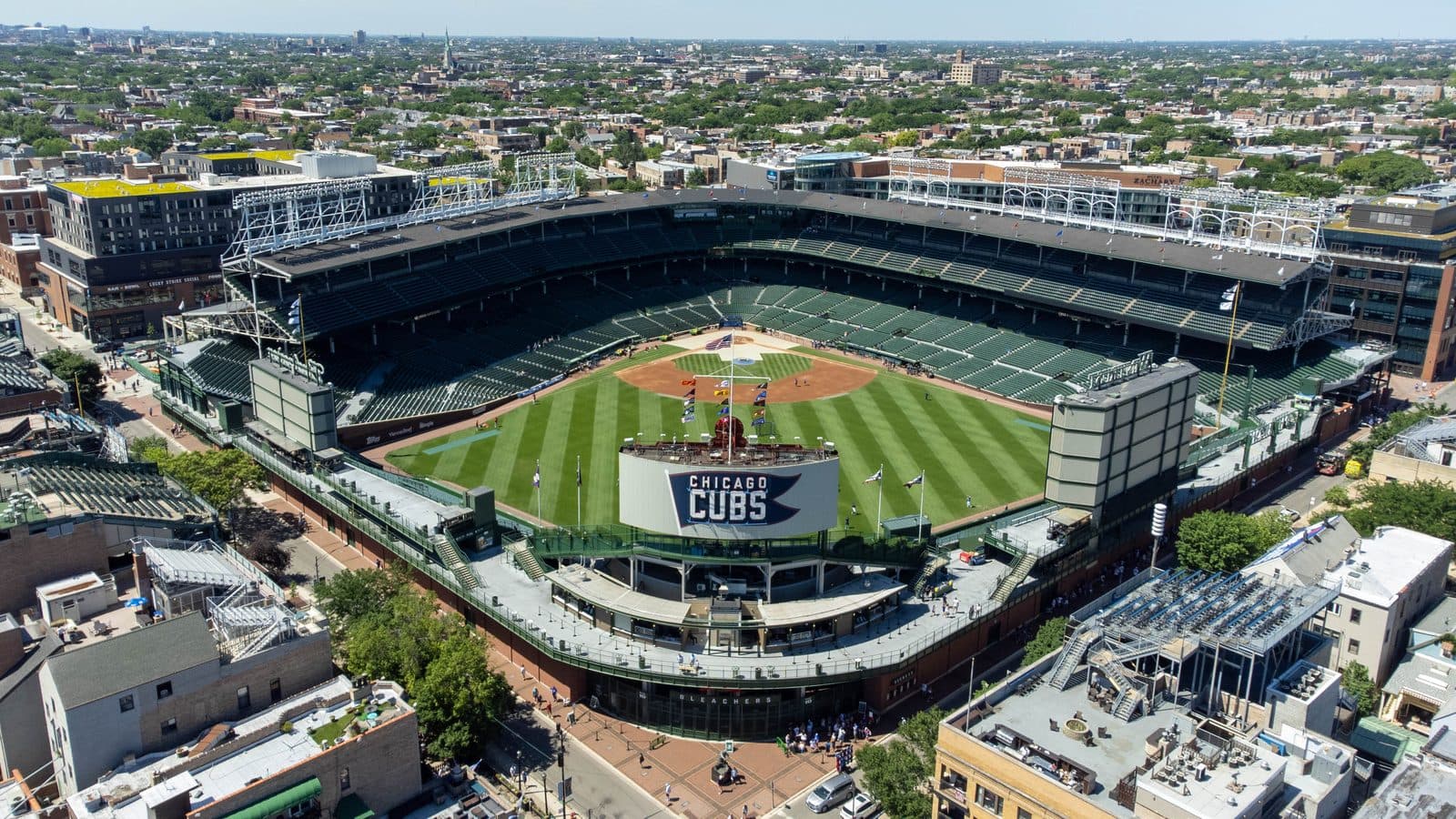
The outfield walls at Wrigley Field stand 11 and a half feet high, brick, and since 1938 they have been covered in Boston ivy, planted with fast-growing Japanese bittersweet to fill the wall in. The ivy was not the first plan. Owner P. K. Wrigley wanted an outdoorsy motif for the remodeled bleachers and installed Chinese elms atop concrete steps flanking center field, but strong winds repeatedly blew them off. Bill Veeck, son of the team's president, then copied a solution he had seen at an Indianapolis ballpark and planted ivy on the outfield brick walls instead.
The wall and the vine arrived as part of a 1937–38 remodeling that also produced the boomerang-shaped bleacher configuration and the 27-by-75-foot center-field scoreboard, designed by the Chicago firm Holabird & Root. The dimensions set then — 355 feet to left, 400 to center, 353 to right — are the ones that stand today.
The Ground Under It
The park opened in 1914 as Weeghman Park, built on the site of the former Chicago Lutheran Theological Seminary for the Chi-Feds of the Federal League. Architects Zachary T. and Charles G. Davis designed the original single-deck concrete-and-steel grandstand at a reported cost of about $250,000. When the Federal League folded, Weeghman and nine other investors including William Wrigley bought the Cubs and moved them in from the West Side Grounds in 1916. The park was renamed Cubs Park in 1920 and became Wrigley Field in 1926.
The largest structural changes came in 1927 and 1928, when stands were doubled down the third and first base lines, pushing capacity to 38,400 and making the Cubs the first National League team to surpass one million in attendance in a single season. The upper deck was set back from the lower, and its rooftop dormers are still visible from the street. The park also served as the longtime home of the Chicago Bears and saw the professional debut of Red Grange in 1925.
Nine Innings, No Hits
On May 2, 1917, Cubs pitcher Hippo Vaughn and Reds pitcher Fred Toney both carried no-hitters through nine innings. Vaughn gave up two consecutive hits in the tenth and lost. Toney completed his no-hitter. It was called a double no-hitter at the time; modern rules credit only Toney.
Reporting: City of Chicago, SABR. Park data: MLB StatsAPI and Retrosheet, via the Fever engine.
By the Desk · filed 2026-07-24 — the piece reads as of its filing; the park record around it is live · every fact in this piece comes from a filed, sourced research pack and clears an independent fact-check, and nothing is edited after filing.
The dimensions
Fence distances from home plate, in feet — the same venue.fieldInfo the scorecards draw their hit charts on.
| Left field line | 355′ |
| Left-center | 368′ |
| Center field | 400′ |
| Right-center | 368′ |
| Right field line | 353′ |
Home club
Games we’ve scored here
81 games at this park in our books — every one transcribed mark for mark, reconciled to the official line. The most recent:
- 2026-09-24MIA 1 – 2 CHC
- 2026-09-23MIA 3 – 2 CHC
- 2026-09-22MIA 8 – 2 CHC
- 2026-09-16ATL 4 – 8 CHC
- 2026-09-15ATL 6 – 3 CHC
- 2026-09-14ATL 3 – 7 CHC
- 2026-09-13PIT 4 – 3 CHC
- 2026-09-12PIT 3 – 4 CHC
- 2026-09-11PIT 2 – 12 CHC
- 2026-09-03MIL 1 – 2 CHC
- 2026-09-02MIL 9 – 5 CHC
- 2026-09-01MIL 9 – 4 CHC
…and 69 more in the scorecard archive.
Where it stands
1060 West Addison, Chicago, IL 60613-4397. Open the map →
From the record
CHF:1914-15; CHN:1916-date
Retrosheet park CHI11 · first game 4/23/1914
Sources
- MLB StatsAPI · as of 2026-07-23
- Retrosheet · as of 2026-07-23
The information used here was obtained free of charge from and is copyrighted by Retrosheet. Interested parties may contact Retrosheet at 20 Sunset Rd., Newark, DE 19711.