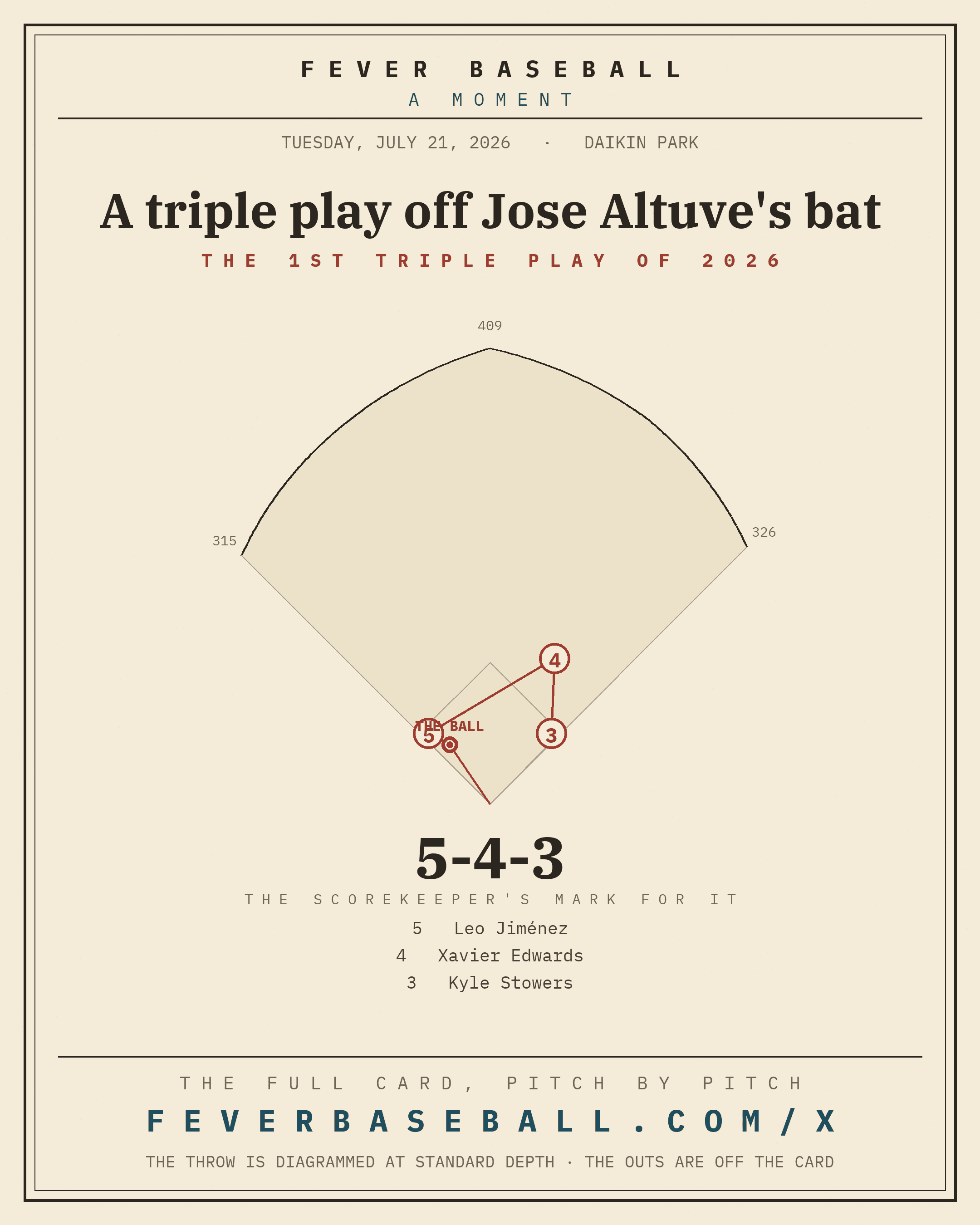
The ball left Jose Altuve's bat in the eighth inning and went to Leo Jiménez.
Two throws later, three Astros were out. Jiménez, Miami's third baseman, threw to second baseman Xavier Edwards, who threw to first baseman Kyle Stowers. Yordan Alvarez out at third. Isaac Paredes out at second. Altuve out at first. Inning over, on one batted ball.
The scorecard writes it 5-4-3 — third baseman to second baseman to first baseman, the order the ball traveled. It is the notation for a force triple play, the version where each fielder catches, touches his base, and relays. No tags. No judgment. The ball moving faster than three men running.
What makes it hard is not any single throw. It is that every step has to be right, and the first out has to arrive fast enough that the second and third are still possible. Jiménez had to field the ball and get rid of it knowing he was starting a chain, not finishing one. Edwards had to catch, step on second, and throw — a pivot where the whole thing collapses if the ball drifts. Stowers had to stretch and hold the base. All of it had to finish inside the time it took Altuve to run ninety feet.
This was the first triple play of 2026. It is late July, and across the league nobody had turned one until a ground ball found Jiménez's glove in the eighth at Daikin Park. Triple plays are rare because the situation is rare — runners on base, force plays available, a ground ball to the infielder who can begin the relay. Then the relay has to hold.
Altuve had already hit into a double play this same game. That one went shortstop Otto Lopez to the same Edwards to the same Stowers, Alvarez out at second. Both killings went through Edwards at the pivot. Both needed two throws. The triple play just began with Jiménez stepping on third before he released the ball — one extra out, same number of throws.
The score was Miami 3, Houston 5. The Astros were ahead, the inning was theirs to extend — and then the ball went to Jiménez and did not stop moving until Stowers caught it at first.