Current MLB ballpark · 1995 – present
Coors Field
Denver, CO
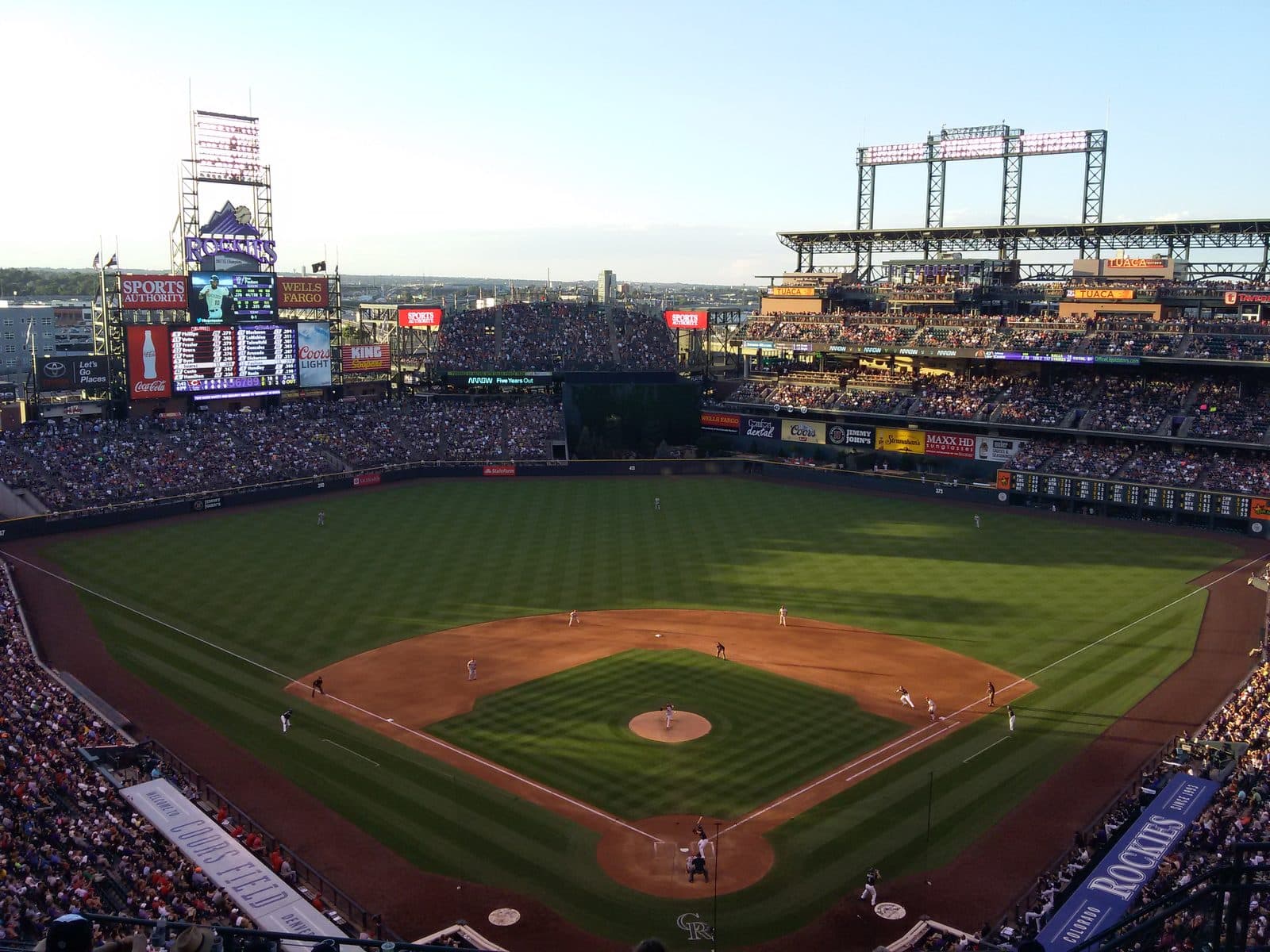
- Opened
- 1995
- Capacity
- 50,144
- Surface
- Grass
- Roof
- Open
- League
- NL
- Elevation
- 5190 ft
- Orientation
- 4° (N)
- Time zone
- America/Denver
How it plays
Every number is an index where 100 is league average. There is no such thing as one park factor — this park does different things to a triple than it does to a home run, and the only honest version is the whole row. Off 18,121 plate appearances in 2026.
| 2026 | 2024-2026 | |
|---|---|---|
| Runs | 117 | 125 |
| Home runs | 105 | 108 |
| Triples | 253 | 215 |
| Doubles | 125 | 123 |
| Singles | 108 | 115 |
| Walks | 86 | 96 |
| Strikeouts | 93 | 90 |
| Value on contact | 110 | 112 |
| Expected on contact | 101 | 101 |
How much of this is the park? Across 2022–2026, this venue's single-season value-on-contact index moved by ±1.8 points (a 5-point spread over 5 seasons). The league median is 3.0. Read a single season's figure with that much slack in it — the walls do not move, and the number does.
By the batter's side
| Runs | 112 RHB | 123 LHB |
| Home runs | 101 RHB | 109 LHB |
| Value on contact | 110 RHB | 110 LHB |
8,520 right-handed and 9,601 left-handed plate appearances — each side is half a season, so read these with at least the slack the combined figures carry — the band above is ±1.8 on twice this sample.
What FVR does about it
Every luck gap we measure at this park has +0.0168 subtracted from it, off 4,498 balls in play here this season. That is the number behind every board on this site, which is the only reason it is printed. It is not on the 100-is-average scale above: it is value on contact per ball in play, so it cannot be added to or subtracted from any index in this table. The two can even point opposite ways — Savant's runs index counts all offense, ours is only the residual against what the batted balls deserved.
Index figures: Baseball Savant, single-season and three-year rolling. What a park factor is, and is not →
The lore
Coors Field: A Mile Marked in Purple
The highest-elevation park in Major League Baseball, where deep fences and a humidor met thin air.
A Mile Marked in Purple
There is a band of purple seats in the upper deck at Coors Field — the 20th row — marking exactly one mile above sea level. The ballpark sits at 5,200 feet, the highest elevation of any park in Major League Baseball, where the air is thin enough that a baseball carries measurably farther off the bat than it does anywhere else in the league.
Built for the Air
The Rockies played their first two seasons at Mile High Stadium while their permanent home went up in Denver's Lower Downtown, near the Union Pacific railroad tracks, in the neighborhoods of Five Points, LoDo, and RiNo. HOK Sports designed the park with a retro feel — hand-laid brick on the outer facade, a clock tower above the main entrance — and pushed the outfield fences deep to compensate for the thin air: 415 feet to center, 420 to left-center, 424 to right-center. In deep center field, 2,300 seats in the upper deck form a section called the Rockpile, named for the nearby Rocky Mountains.
Coors Canaveral
In 1999, the Rockies and their opponents combined for 303 home runs in a single season — a major-league record — and the park earned the nickname "Coors Canaveral." The first game ever played there, on April 26, 1995, had already hinted at what was coming: the Mets' Rico Brogna hit the park's first home run, Todd Hundley added a grand slam, and Dante Bichette won it 11-9 with a three-run walk-off in the bottom of the 14th. In 1998, the All-Star Game at Coors became the highest-scoring Midsummer Classic in history — the American League beat the National League 13-8 on 31 combined hits and three home runs, with Roberto Alomar taking MVP. By 2002, the Rockies installed an $18 million humidor to store baseballs at controlled humidity and temperature. Home runs fell from 268 in 2001, the most in the majors, to 185 in 2007. Runs per game dropped from 13.4 to 10.6 over the same span.
The 2026 season is the 32nd at Coors Field, and the Rockies still play there.
Reporting: Society for American Baseball Research, Colorado Encyclopedia. Park data: MLB StatsAPI and Retrosheet, via the Fever engine.
By the Desk · filed 2026-07-23 — the piece reads as of its filing; the park record around it is live · every fact in this piece comes from a filed, sourced research pack and clears an independent fact-check, and nothing is edited after filing.
The dimensions
Fence distances from home plate, in feet — the same venue.fieldInfo the scorecards draw their hit charts on.
| Left field line | 347′ |
| Left field | 390′ |
| Left-center | 420′ |
| Center field | 415′ |
| Right-center | 424′ |
| Right field | 375′ |
| Right field line | 350′ |
Home club
Games we’ve scored here
81 games at this park in our books — every one transcribed mark for mark, reconciled to the official line. The most recent:
- 2026-09-24AZ 12 – 8 COL
- 2026-09-23AZ 5 – 3 COL
- 2026-09-22AZ 7 – 2 COL
- 2026-09-20SEA 2 – 1 COL
- 2026-09-19SEA 3 – 5 COL
- 2026-09-18SEA 5 – 4 COL
- 2026-09-17SD 9 – 2 COL
- 2026-09-16SD 9 – 3 COL
- 2026-09-15SD 3 – 9 COL
- 2026-09-14SD 8 – 7 COL
- 2026-09-06STL 10 – 8 COL
- 2026-09-05STL 7 – 10 COL
…and 69 more in the scorecard archive.
Where it stands
2001 Blake Street, Denver, CO 80205-2000. Open the map →
Sources
- MLB StatsAPI · as of 2026-07-23
- Retrosheet · as of 2026-07-23
The information used here was obtained free of charge from and is copyrighted by Retrosheet. Interested parties may contact Retrosheet at 20 Sunset Rd., Newark, DE 19711.