Former ballpark · 1893 – 1920
Robison Field
St. Louis, MO
- Opened
- 1893
- Closed
- 1920
- League
- NL
The lore
Robison Field
A lopsided wooden yard at Natural Bridge and Vandeventer that gave St. Louis twenty-seven National League seasons and never a pennant.
The Shape of the Ground
The dimensions tell you what kind of place Robison Field was before you learn anything else. Left field measured 470 feet. Center field reached 500. Right field was 290. A hitter who pulled the ball had a chance. A hitter who went the other way had a long way to go.
The park opened in the spring of 1893 on the estate of St. Louis real estate broker Jesse G. Lindell. Chris Von der Ahe signed a fifteen-year lease — $1,500 a year for the first eight years, $2,000 for the remaining seven — and the architectural firm of Beinke and Wees put up a wooden grandstand on steel beams and arches for roughly $45,000. Opening day brought a parade from the Lindell Hotel, and 12,230 fans watched the Browns beat the Louisville Nationals 4-2. Beneath home plate, they buried copies of the day's newspapers and The Sporting News.
August 1914
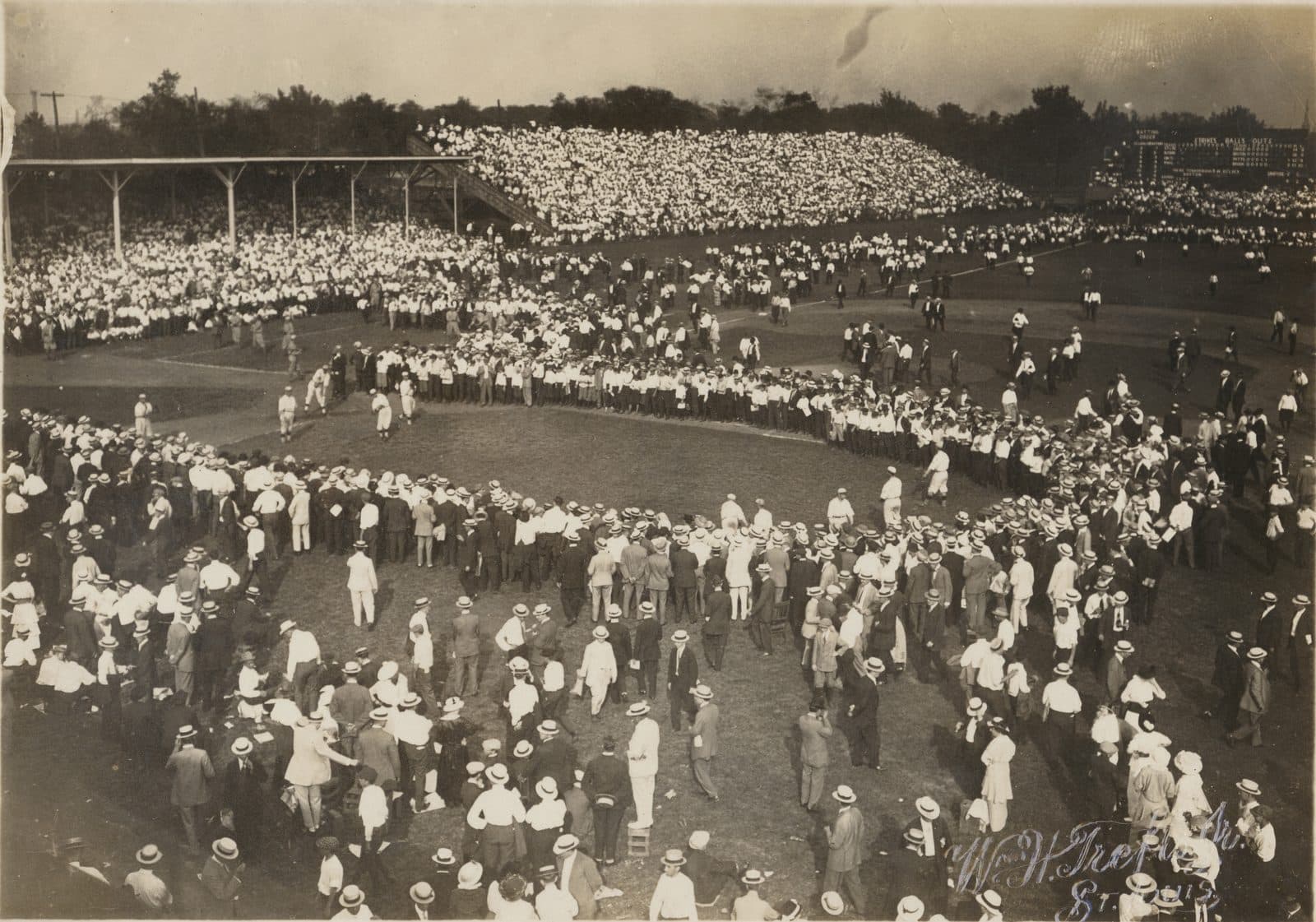
For twenty-seven seasons, National League baseball was played on that ground, and the tenants never won a pennant. They came closest in 1914, when the Cardinals contended in a three-way race with the New York Giants and the Boston Braves. On August 26, an overflow crowd filled the park for a doubleheader against the Giants. The Cardinals won the opener 1-0. Between games, fans swarmed the field, and police intervened. The Giants took the nightcap 4-0. Three days later the Braves swept a twin bill before another overflow crowd, and St. Louis's pennant hopes were finished.
What Stood and What Came After
The Robison brothers bought the property outright for $60,000 from the Lindell estate in June 1906, and in 1909 Stanley Robison spent approximately $6,000 to add concrete sections to either end of the grandstand, extending seating capacity to roughly 20,000. The wooden core kept aging. On June 6, 1920, the Cardinals defeated the Chicago Cubs 5-2 before nearly 15,000 spectators and moved to the rebuilt Sportsman's Park at Grand and Dodier, which the American League Browns had called home since 1902.
In 1922 the site became the property of the St. Louis Board of Education, and Beaumont High School was built on the grounds where right field once stood 290 feet from home plate.
Reporting: SABR, Ballparks.com, Wikipedia. Park data: MLB StatsAPI and Retrosheet, via the Fever engine.
By the Desk · filed 2026-07-24 — the piece reads as of its filing; the park record around it is live · every fact in this piece comes from a filed, sourced research pack and clears an independent fact-check, and nothing is edited after filing.
Where it stood
St. Louis, MO. We don’t have exact coordinates for this park in the historical record — we’d rather say so than pin the wrong spot.
Sources
- Retrosheet · as of 2026-07-23
The information used here was obtained free of charge from and is copyrighted by Retrosheet. Interested parties may contact Retrosheet at 20 Sunset Rd., Newark, DE 19711.