Current MLB ballpark · 1989 – present
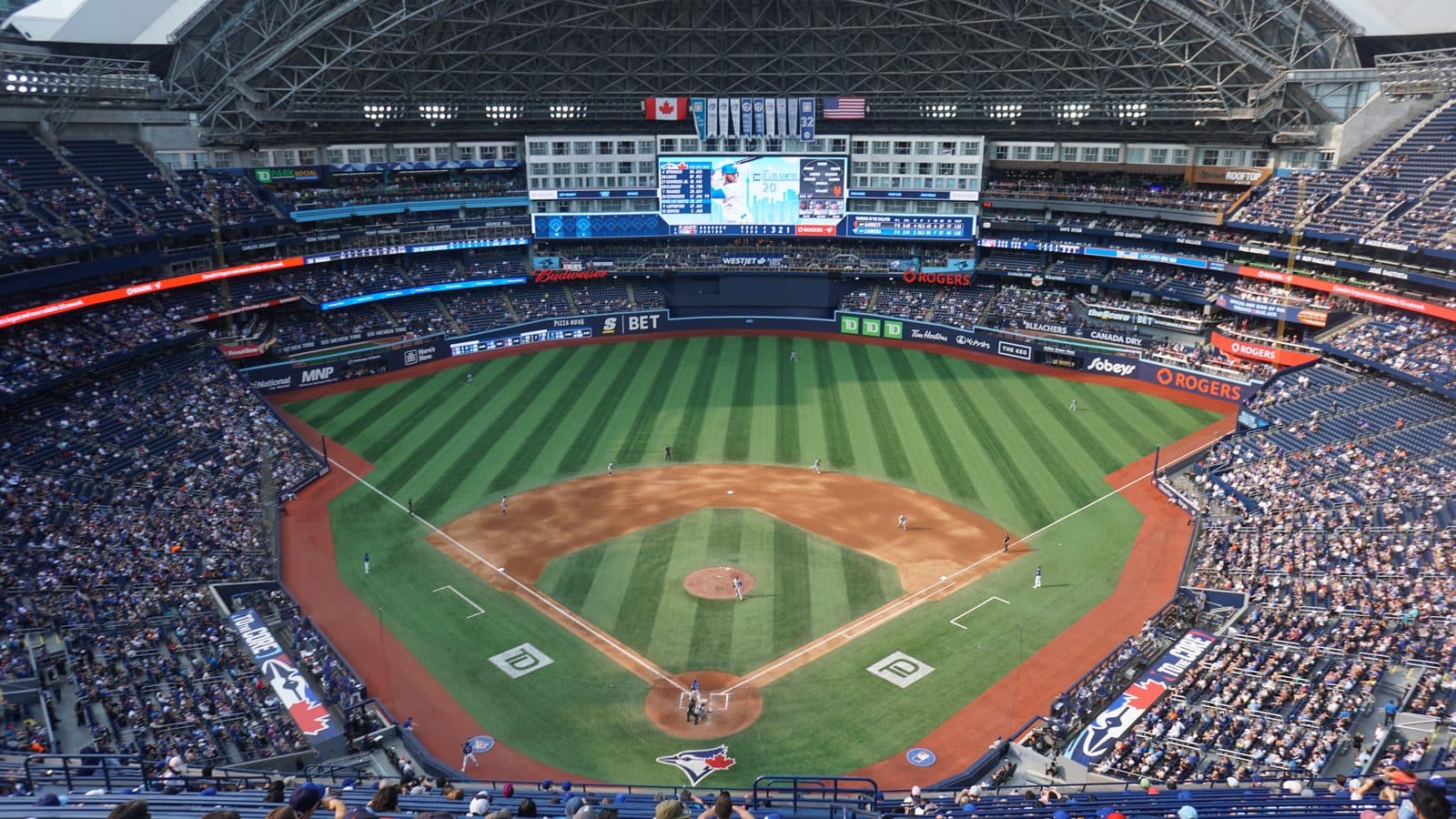
Rogers Centre
Toronto, ON · Canada
Also known as Skydome.
- Opened
- 1989
- Capacity
- 39,150
- Surface
- Artificial Turf
- Roof
- Retractable
- League
- AL
- Elevation
- 270 ft
- Orientation
- 345° (NNW)
- Time zone
- America/Toronto
How it plays
Every number is an index where 100 is league average. There is no such thing as one park factor — this park does different things to a triple than it does to a home run, and the only honest version is the whole row. Off 17,710 plate appearances in 2026.
| 2026 | 2024-2026 | |
|---|---|---|
| Runs | 98 | 102 |
| Home runs | 95 | 105 |
| Triples | 53 | 68 |
| Doubles | 102 | 104 |
| Singles | 101 | 100 |
| Walks | 101 | 100 |
| Strikeouts | 101 | 98 |
| Value on contact | 99 | 100 |
| Expected on contact | 99 | 100 |
How much of this is the park? Across 2022–2026, this venue's single-season value-on-contact index moved by ±2.5 points (a 7-point spread over 5 seasons). The league median is 3.0. Read a single season's figure with that much slack in it — the walls do not move, and the number does.
By the batter's side
| Runs | 100 RHB | 98 LHB |
| Home runs | 99 RHB | 91 LHB |
| Value on contact | 99 RHB | 100 LHB |
9,357 right-handed and 8,353 left-handed plate appearances — each side is half a season, so read these with at least the slack the combined figures carry — the band above is ±2.5 on twice this sample.
What FVR does about it
Every luck gap we measure at this park has −0.0053 subtracted from it, off 4,104 balls in play here this season. That is the number behind every board on this site, which is the only reason it is printed. It is not on the 100-is-average scale above: it is value on contact per ball in play, so it cannot be added to or subtracted from any index in this table. The two can even point opposite ways — Savant's runs index counts all offense, ours is only the residual against what the batted balls deserved.
Index figures: Baseball Savant, single-season and three-year rolling. What a park factor is, and is not →
The lore
The Building That Moves
The Blue Jays' home since 1989, built around a patented retractable roof that drew early skepticism and still runs.
The Thing That Moves
Architects Rod Robbie and Michael Allen designed the building and patented its retractable roof system. The roof has four panels — three slide along rails while one remains stationary. Together they cover 339,343 square feet, stand 282 feet tall at the highest point, and weigh 11,000 tonnes. That is the weight that moves every time the sky opens over the field below.
There was early skepticism about whether the ambitious design would hold up. The technology operated flawlessly on opening day in 1989 and has continued to function since. The park was built in downtown Toronto near Union Station, a site chosen to capitalize on existing public transit connections instead of surface parking. The Blue Jays have been the only major-league tenant — first under the name SkyDome, later as Rogers Centre — and the 2026 season is the 38th season of baseball at this park.
Closed Air, Symmetrical Fences
The dimensions run symmetrical: 328 feet down both lines, 375 to the gaps, 404 to dead center, on artificial turf. The park holds 49,282. What shapes the game inside those fences has less to do with the distances than with the roof's position. The park generally favors hitters, and the ball travels well when the roof is closed — which, through a Toronto spring and into the early summer, is often.
The building filled up fast. In 1991, the Blue Jays became the first baseball team to attract four million fans in a single season at the venue. That same year the park hosted the All-Star Game, a 4–2 American League victory. Two seasons later, Game 6 of the 1993 World Series: Joe Carter hit a walk-off home run against the Philadelphia Phillies to win the championship, one of baseball's most famous moments at the stadium.
The roof still opens and closes on its rails, 38 seasons in — the same mechanism Robbie and Allen patented.
Reporting: SABR, Wikipedia, MLB.com, Baseball Reference, The Globe and Mail. Park data: MLB StatsAPI and Retrosheet, via the Fever engine.
Since we filed
2026-07-24
A correction to what we filed. The capacity given above — 49,282 — is the pre-renovation figure, and it was already out of date when the piece was filed. A two-stage renovation of roughly $400 million, completed in 2024, turned the multi-purpose SkyDome into a ballpark-first venue and cut seating to 39,150 (41,500 for the 2023 season, then 39,150 for 2024). The field dimensions and the retractable roof are unchanged.
Reporting: MLB.com. Park data: MLB StatsAPI and Retrosheet, via the Fever engine.
By the Desk · filed 2026-07-24 — the piece reads as of its filing; the park record around it is live · every fact in this piece comes from a filed, sourced research pack and clears an independent fact-check, and nothing is edited after filing.
The dimensions
Fence distances from home plate, in feet — the same venue.fieldInfo the scorecards draw their hit charts on.
| Left field line | 328′ |
| Left-center | 375′ |
| Center field | 404′ |
| Right-center | 375′ |
| Right field line | 328′ |
Home club
Games we’ve scored here
81 games at this park in our books — every one transcribed mark for mark, reconciled to the official line. The most recent:
- 2026-09-27CIN 1 – 5 TOR
- 2026-09-26CIN 5 – 1 TOR
- 2026-09-25CIN 5 – 6 TOR
- 2026-09-16DET 1 – 5 TOR
- 2026-09-15DET 10 – 1 TOR
- 2026-09-14DET 6 – 5 TOR
- 2026-09-13BAL 1 – 8 TOR
- 2026-09-12BAL 3 – 7 TOR
- 2026-09-11BAL 7 – 4 TOR
- 2026-08-30SEA 0 – 7 TOR
- 2026-08-29SEA 3 – 4 TOR
- 2026-08-28SEA 1 – 8 TOR
…and 69 more in the scorecard archive.
Where it stands
1 Blue Jays Way, Suite 3200, Toronto, ON M5V1J1. Open the map →
Sources
- MLB StatsAPI · as of 2026-07-23
- Retrosheet · as of 2026-07-23
The information used here was obtained free of charge from and is copyrighted by Retrosheet. Interested parties may contact Retrosheet at 20 Sunset Rd., Newark, DE 19711.